Overview
Your spend moves every day, and the story of where it went is spread across thousands of invoices. The Cost Analysis Dashboard pulls that story into one place. It shows you where your money goes over time, and lets you open any line all the way down to the invoice it came from.
This is a rebuilt version of the original Cost Analysis Dashboard. It now works for both legacy GL accounts and accounts on Enhanced Dimensions, and it groups your spend by GL account, department, vendor, category, company, location, project, and any other dimension your account is set up with. Every table lets you search, sort, drill down, and export to CSV.
The dashboard also includes the Hot List, which tracks item-level price changes and shows every item you bought, so you can catch a vendor price creep before it eats your margin.
The data updates automatically with every invoice Ottimate processes.
This dashboard helps you answer questions like:
Which GL accounts, categories, or vendors are driving my spend this quarter?
How much did I spend with a specific vendor last month, and at which locations?
Which item prices have moved, and what is that change costing me?
How it works
The dashboard reads the invoices Ottimate has processed for the locations you can see, and groups the line items by whatever dimension you pick. Every number is calculated on the invoice date, so the date filter controls when the invoice was issued, not when it was paid.
A few things worth knowing:
Total spend is every invoice line in your date range. Coded to a GL account is the portion that carries a GL account or accounting dimension, which is what the Vendor, Category, and Hot List views work from.
Each tab shows the lines that carry a value for that grouping, with a coverage line telling you how much of your spend that covers. For example, the Location tab shows the share of spend that has a location on it.
Costs that come from outside the invoice flow, such as labor, rebates, or journal entries made directly in your ERP, are not tracked here. The dashboard reflects invoiced spend.
Where can I find the Cost Analysis Dashboard?
Open it from the Dashboards section of the Reports module.
Reports → Dashboards → Cost Analysis
How do I use the Cost Analysis Dashboard?
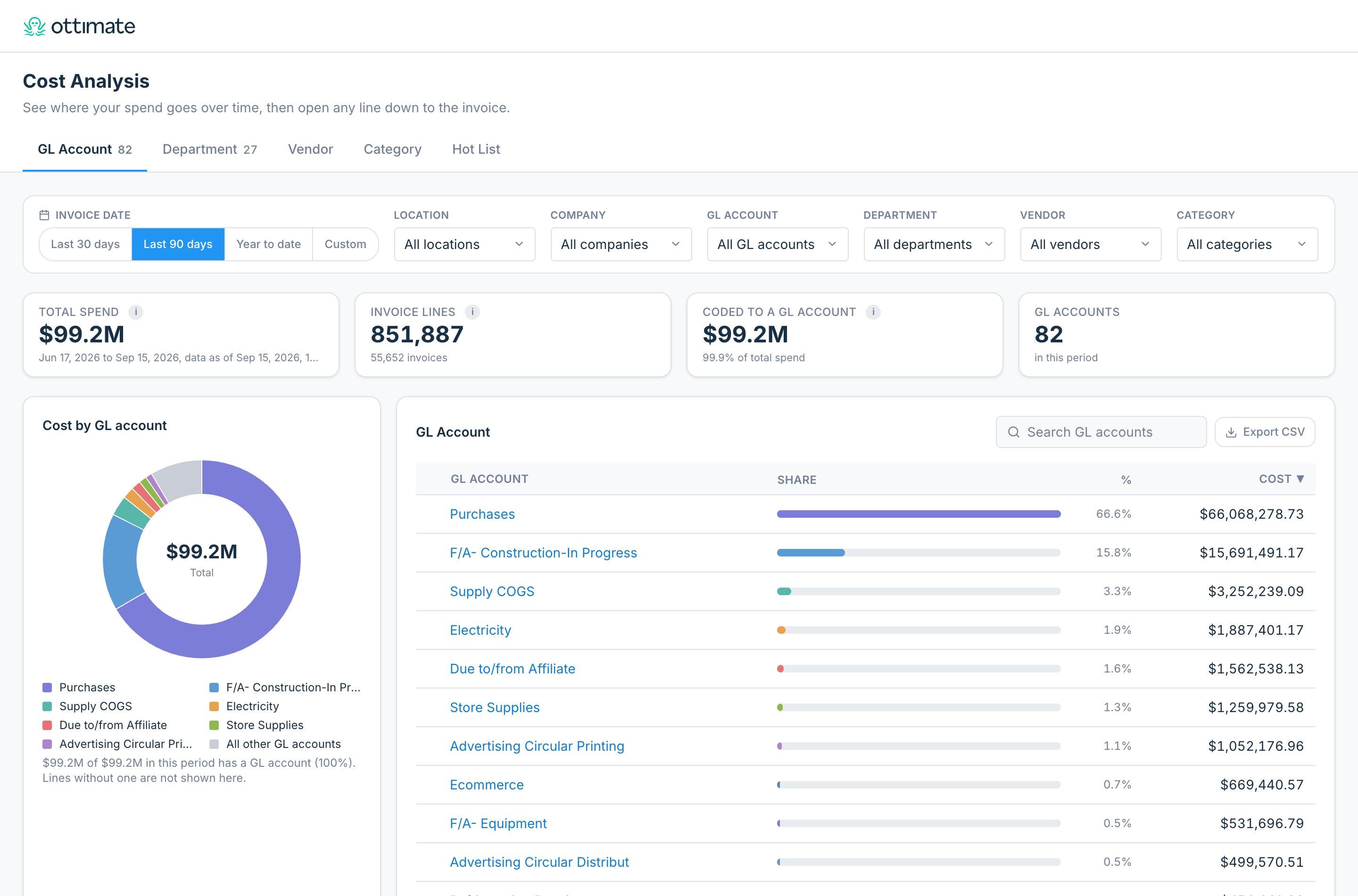
Pick a tab across the top to choose how your spend is grouped, then use the filters to narrow it down. Each tab gives you a donut chart of the mix, a ranked table of the values, and a weekly trend. Click any row to drill into it, and keep clicking until you reach the invoice.
The tabs you see depend on how your account is set up:
Legacy GL accounts see GL Account, Department, Vendor, Category, and Hot List.
Enhanced Dimensions accounts see Account, Location, Department, Project, and any other configured dimension, plus Vendor, Category, and Hot List.
Apply a filter and every chart and table updates to match.
How do I use the date filter for a specific invoice date range?
Use the presets in the top left for the common ranges: Last 30 days, Last 90 days, or Year to date.
To set your own range, click Custom.
Pick a start date and an end date. The dashboard updates every chart and table to that invoice date range.


What are the elements of the Cost Analysis Dashboard?
Each tab is built from the same three pieces, plus a search box and a CSV export.
Donut chart. The donut shows how the top values contribute to your total spend, with everything else grouped into "All other." It sits on the left of each tab so you can see the mix at a glance.
Ranked table. The table lists every value in order of spend, with its share and cost. Click a column header to sort by it, and click again to flip the order. Click any row to drill into it.
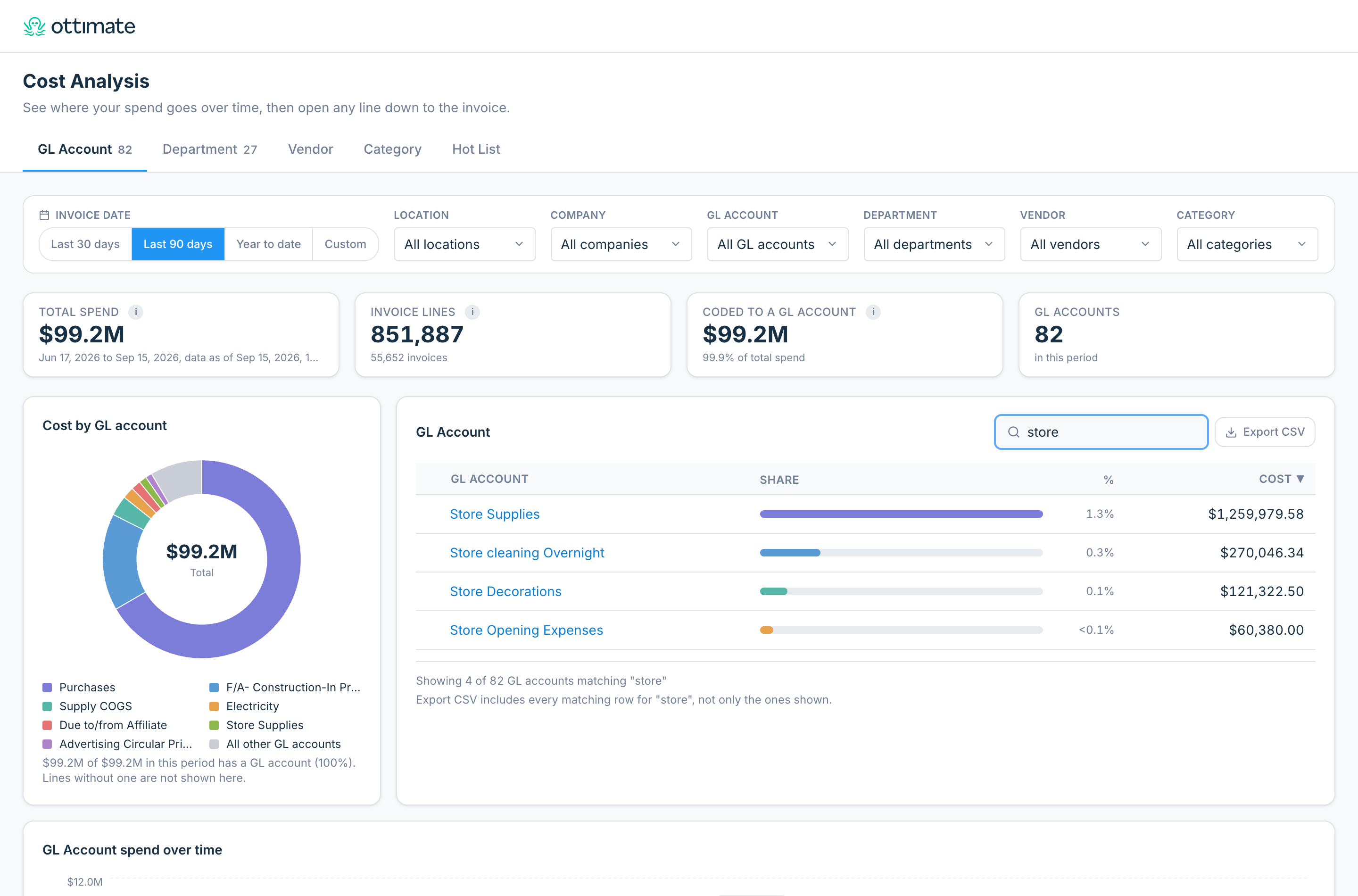
Search. Each table has a search box in its header. Type a name to jump to any value, even one far down a long list, without scrolling. The search runs across every value in the tab, and the footer tells you how many matched. Your CSV export always includes every matching row, not only the ones on screen.
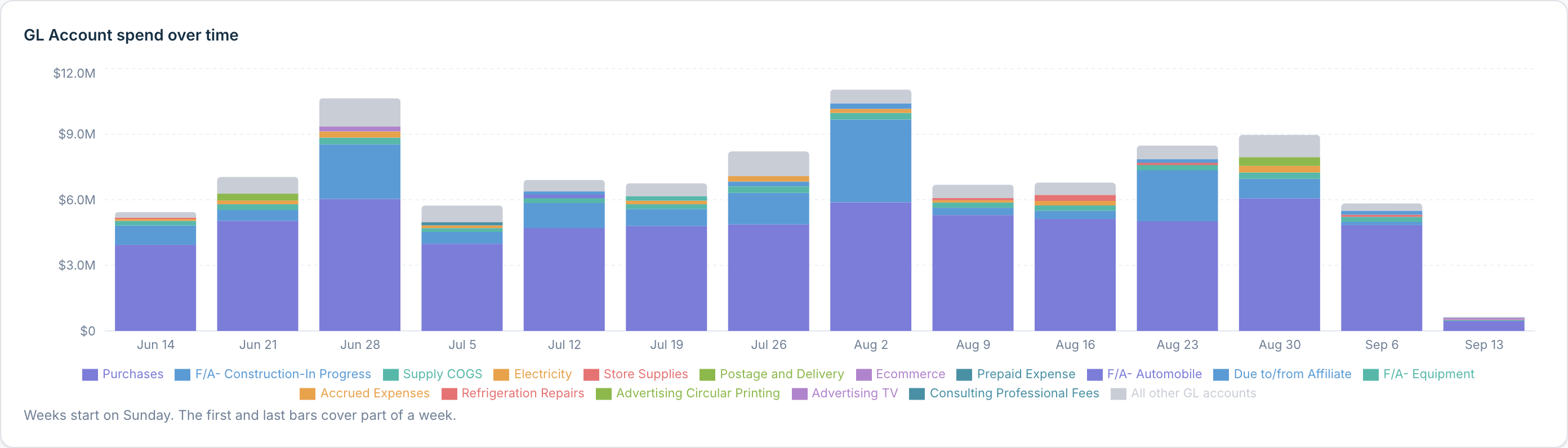
Weekly trend. Below each table, a stacked bar chart shows your spend week by week, colored by the top values. It shows how your mix shifts over the range.
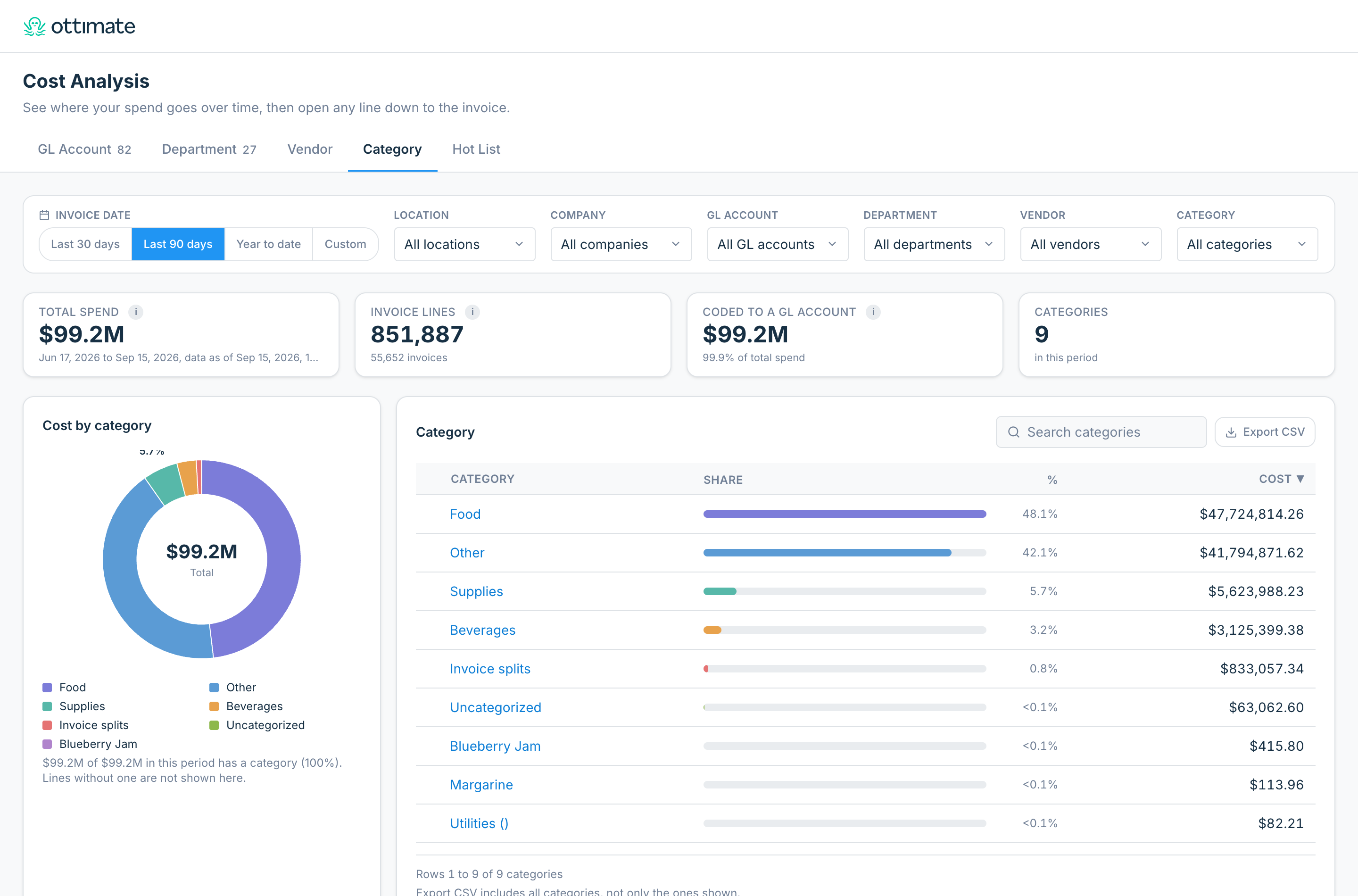
Category and sub-categories. The Category tab groups your spend into top-level categories. Click a category with sub-categories, such as Food, to open them, then click a sub-category to reach its invoices. Spend that comes from a manual invoice split shows as its own Invoice splits row, so it is never mixed in with uncategorized lines or counted twice.
Drill down to the invoice. From any tab, drilling down leads to the invoices behind the number, and then to the individual line items. Click an invoice number to open that invoice in Ottimate.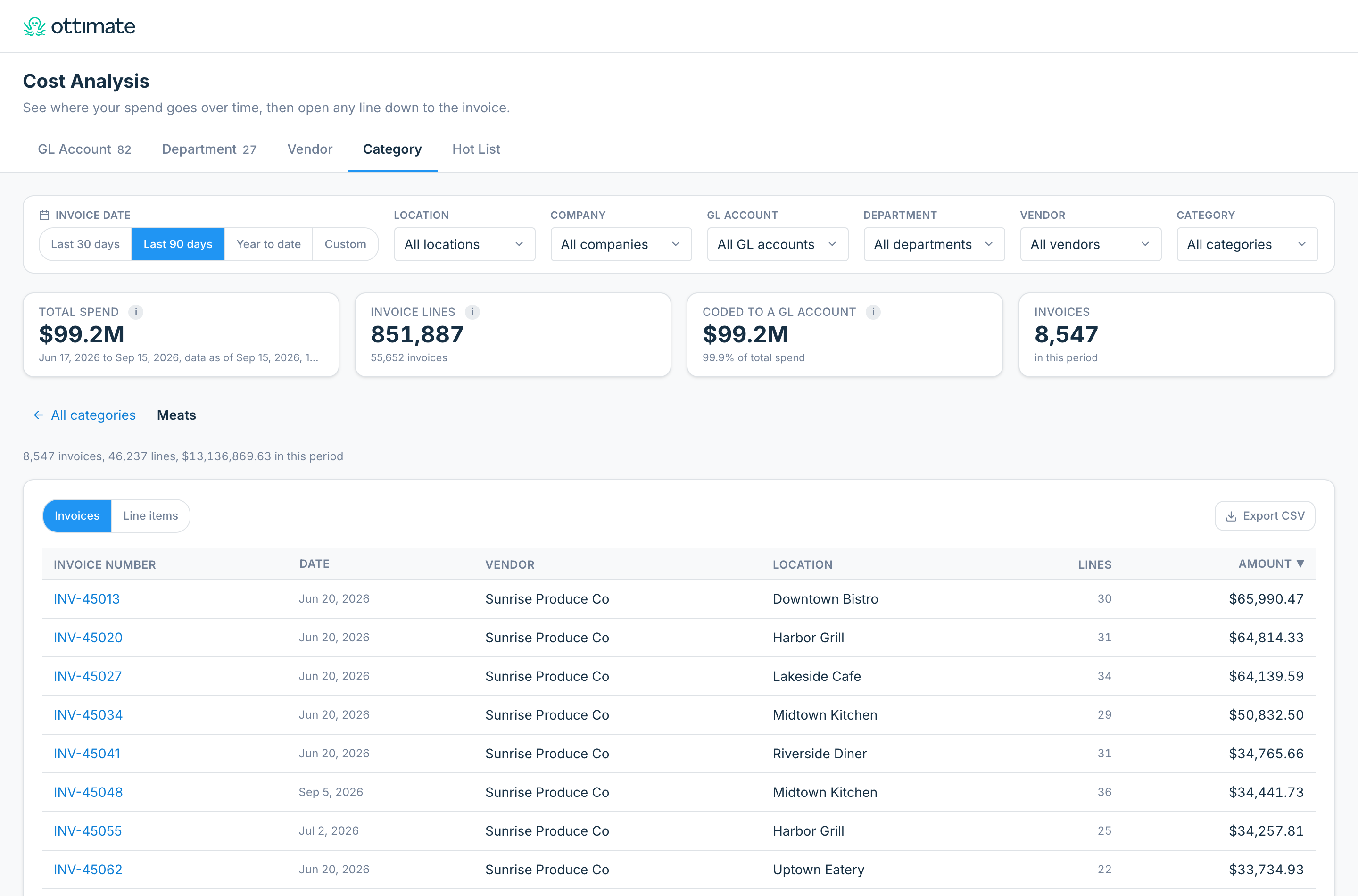
What is the Hot List?
The Hot List tracks what your items cost and how those costs move. It has two views, and you switch between them with the toggle at the top.
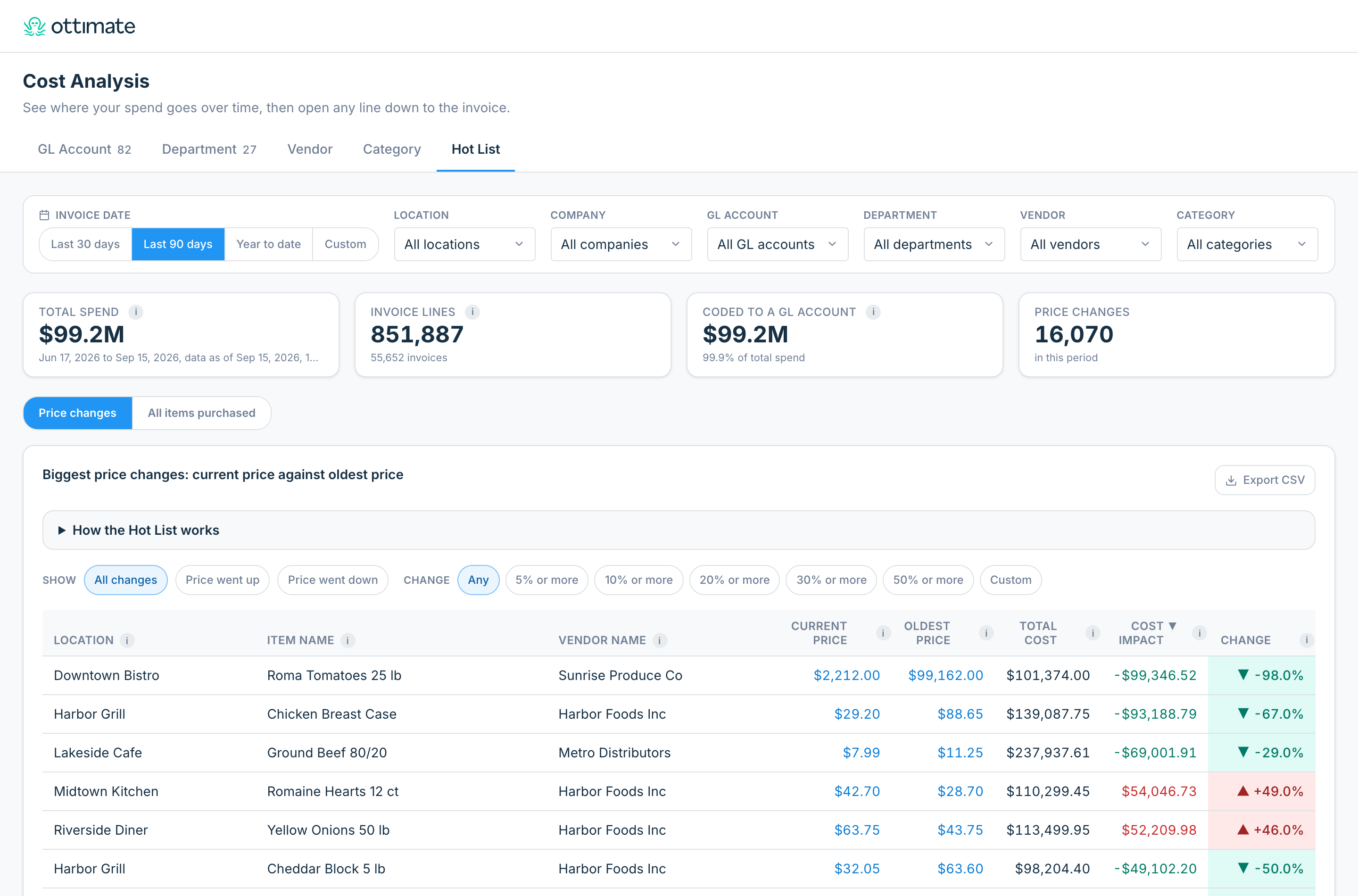
Price changes. This view compares each item's most recent unit price against its oldest price in the range, and lists the items whose price moved. A price increase shows in red, a decrease in green. The list defaults to a smart order that surfaces the changes that cost you the most money first, using how much the price moved, how often you buy the item, and how much of it you buy. You can also filter by direction (up or down) and by how big the change is, down to a custom range you type in.
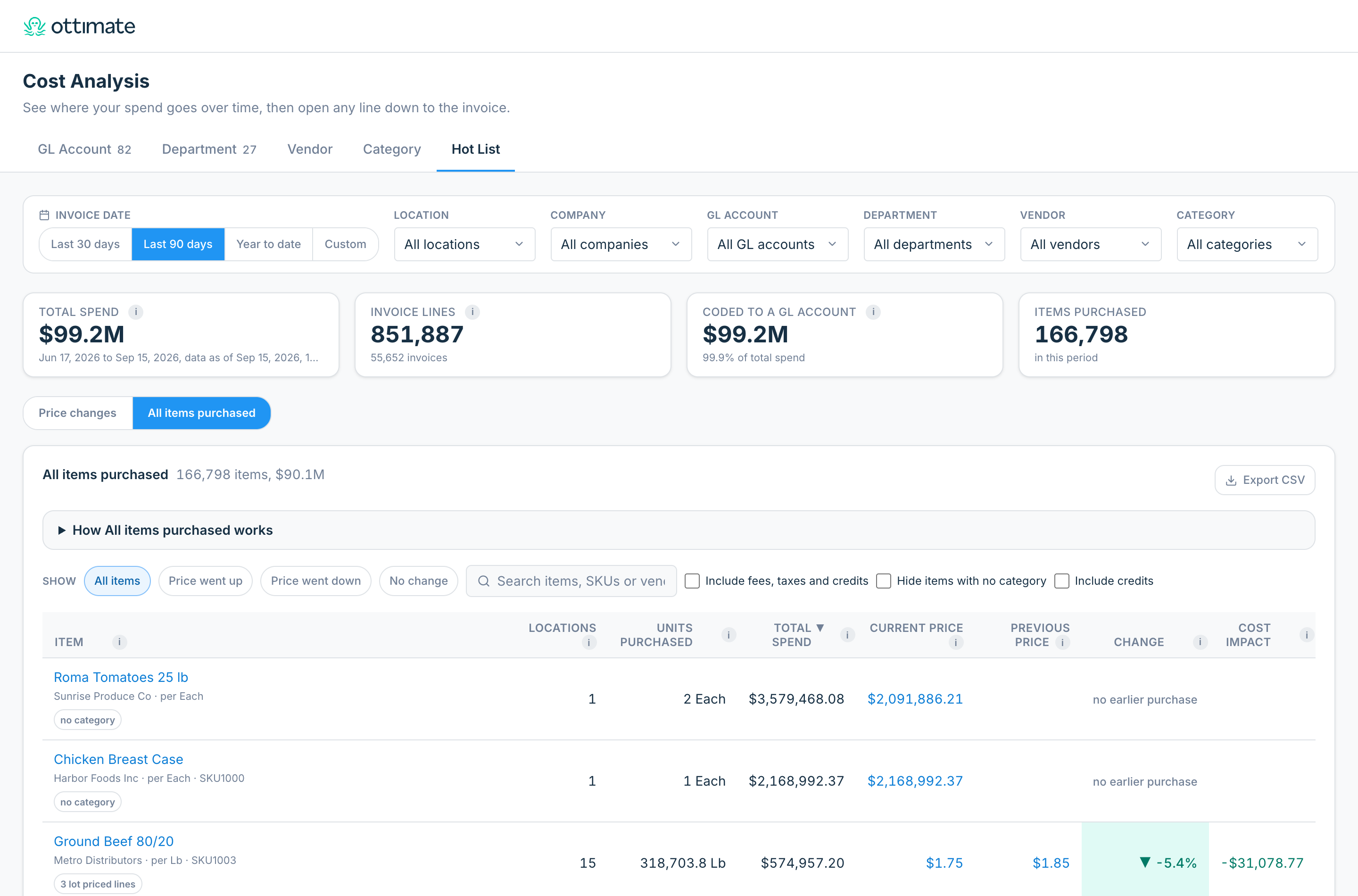
All items purchased. This view lists every item you bought in the range, one row per item and vendor, with the quantity you purchased, the current and previous unit price, and the change. Use it to review your full purchasing, not only the items that moved.
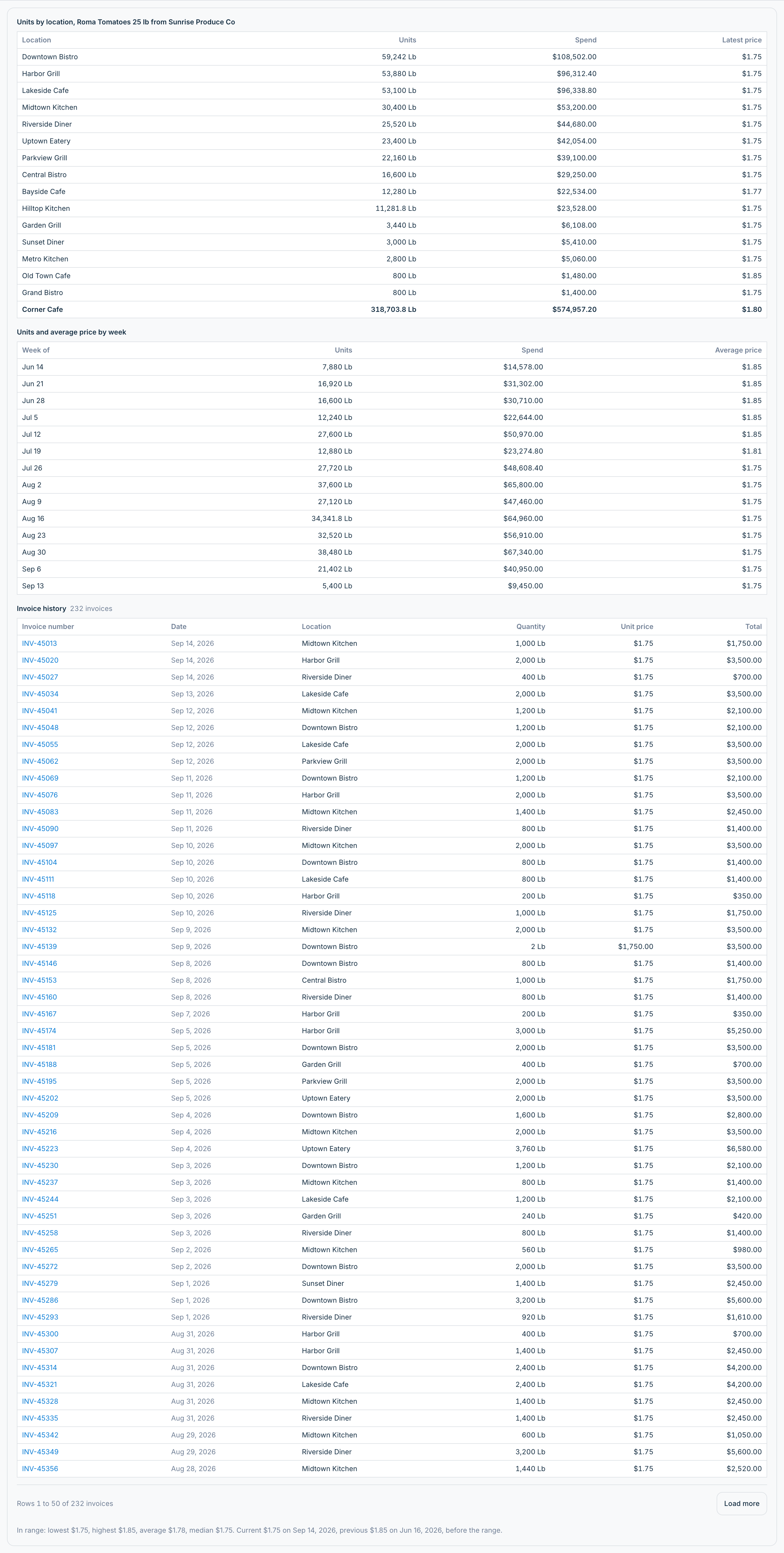
Item detail. Click any item to open it. You see which locations bought it, the units and average price week by week, and the full invoice history for that item. Click any invoice to open it in Ottimate.
What does Cost Impact mean? Cost Impact is what a price change is worth at the volume you buy. It multiplies the price change by the total you purchased in the range, so a small change on a high-volume item can outrank a large change on something you rarely buy. Change the date range or your purchasing and the Cost Impact changes with it.
The Hot List helps you answer questions like:
How much has this item's price changed since I last bought it?
What is that new price going to cost me over the range?
Which item prices should I be watching most closely?
Filters available on the dashboard
The filters sit under the header and apply to every tab.
Invoice date: presets (Last 30 days, Last 90 days, Year to date) or a custom start and end date. All numbers are based on the invoice date.
Location: filter to one or more locations you have access to.
Company: filter to one or more companies. Shown when your account has more than one.
GL account, Department, Vendor, Category: narrow the whole dashboard to specific values. Each is searchable.
You only ever see the locations your role gives you access to. A filter never widens that.
What can I learn from the Cost Analysis Dashboard?
How much did I spend last week, last month, or last quarter?
How much did I spend with a specific vendor, and at which locations?
How much did a company or location spend in a period?
How much did I spend on a category such as produce or meat?
How has the price of a specific item changed over time, and what is it costing me?
Access and Pricing
The Cost Analysis Dashboard is included as a standard report at no extra cost. It is available to any user whose role is not view-only.
If you or someone on your team cannot find the dashboard, they are likely on a "View" or "No-Access" role. Ask a user with Administrator role permissions to enable the "View Analytics Dashboards" permission for the user who needs access.
FAQs
Q. Does the dashboard work for Enhanced Dimensions accounts?
Yes. Accounts on Enhanced Dimensions see tabs for Account, Location, Department, Project, and any other configured dimension, and their spend is grouped by those dimensions. Legacy GL accounts see GL Account and Department. The dashboard picks the right model for your account automatically.
Q. How are items categorized, and what happens with invoice splits?
Categories come from the line item. When an invoice is split across GL accounts or dimensions, that split spend is shown as its own "Invoice splits" row on the Category tab, so it lands in the right accounts and dimensions elsewhere in the dashboard and is never counted twice.
Q. Why do some categories show as "Uncategorized"?
"Uncategorized" holds the line items that do not carry a category. It is separate from "Invoice splits," so you can tell coded split spend apart from lines that simply have no category yet.
Q. Does the dashboard include cost accounting from my ERP?
No. Costs that come from outside the invoice flow, such as labor, rebates, or manual journal entries, are not tracked here. The dashboard reflects invoiced spend.
Q. Can I export the data?
Yes. Every table has an Export CSV button. When a search is active, the export includes every matching row, not only the rows on screen.
Q. Can I see data from locations I don't have access to?
No. The dashboard only shows the locations your role gives you access to, and filters can narrow that but never widen it.
Q. How current is the data?
The dashboard updates automatically as Ottimate processes your invoices.
Q. Who can access the dashboard?
Any user whose role is not view-only, with the "View Analytics Dashboards" permission. Ask an Administrator to enable it if you cannot find the dashboard.
Additional Info
For further assistance, contact Ottimate Support by emailing support@ottimate.com or click the link here and submit a support ticket.
Was this article helpful?
That’s Great!
Thank you for your feedback
Sorry! We couldn't be helpful
Thank you for your feedback
Feedback sent
We appreciate your effort and will try to fix the article